
Outline
- Requirements
- Assessment Summary – Results up Front
- Assessment Register - Origins
- Legal MAiD Competency
- Rational Decision Making
- Competence & Mental Status
- Scoring - Binary Plus Scoring Key and Scales
- MAiD Competence Evaluation 17 Items
- Competence of Helpers
- Oswaldo Escalante
- External Quality Review
- The Clinic – Central City Community Health Center – Garden Grove
- Martha Gil
- Bios and Profile – Keith Torkelson, MS, BS
- Progressive Competency 16 Items
- Progressive Competency 15 Items
- Progressive Competency Performance 18 Items
- Progressive Stages 6 Items
- Progressive Competency Gaps 27 Items
- Partnership RDA Version Summary of 16 Items
- FYI - Mental Health Assessment (2012 - 208 Pages)
- The Meaning of Redacted
- Informed Consent – Competence
- LPS Conservatorship
- Competency Content
- Why are skilled nursing facilities locked facilities?
- Mental Health Assessment
- Mini Mental State Examination
- Appendix – BHSA Vision Mission Values
- Appendix – Acronyms


Assess_Partnership_RDA_16070202_Gibbs V2019
MHSA_INN_HAB_18121302_VMV 2025
Feature Assessment
HHS-P-VMV HHS-P-Value – Mission - Vision OCHCA-MHSA
Legal - MAiD Competency
Medical Assistance in Dying (MAiD) competency requires the
patient to have the decision-making
capacity to understand their medical condition, the nature of MAiD, its
irreversibility, and alternatives. Assessors (physicians/nurse practitioners)
must confirm voluntary, informed consent without coercion, assessing for cognitive impairments that may
affect judgment.
Key Aspects of MAiD Competency Assessment
Capacity Definition:
Patients must demonstrate the ability to understand information relevant to their medical condition, potential treatments, and the consequences of choosing MAiD.
Contextual Evaluation:
Capacity is decision-specific, not global. It focuses on whether the person understands what MAiD is and what their request means.
Assessing Capacity:
If capacity is questionable, a specialized assessment (e.g., psychiatrist, psychologist) may be required.
Timing:
The patient must possess the capacity to make the request, but legal standards for capacity at the very moment of the procedure (final consent) can vary based on legislation.
Clinical Competencies for MAiD Providers:
Knowledge of Regulations:
Thorough knowledge of current MAiD legislation, professional obligations, confidentiality, and informed consent is essential.
Interpersonal Skills:
MCCs (MAiD Care Coordinators) must effectively communicate and handle the emotional, ethical, and cultural complexities of the process.
Documentation:
Accurate, detailed documentation
of the request, assessment, and consent is mandatory.
Note:
In Canada, if the only medical condition is a mental
illness, eligibility for MAiD is not available until March 17, 2027.
MAiD Medication
Medical Assistance in Dying
(MAID) utilizes specialized, high-dose
medication protocols to cause peaceful, rapid death, typically within
1–2 hours. Common protocols involve a combination of drugs—often Midazolam
(sedation), Propofol (coma), and Rocuronium (muscle paralysis)—or mixtures
containing digoxin, diazepam,
morphine, and amitriptyline.
Communication of choice
"Communication of
choice" refers to selecting the
most effective method, channel, or style—such as verbal, non-verbal,
visual, or written—to convey messages, build relationships, and ensure clarity,
particularly within organizational leadership, personal, or AAC (Augmentative
and Alternative Communication) contexts. It is a strategic, often conscious
decision used to minimize
misunderstandings and maximize impact.
Understanding of information - Data,
Information, Knowledge and Wisdom
Understanding information
involves Information Literacy—the skills to find, evaluate, and use information
ethically—and Cognitive Processing—how we connect new data to existing
knowledge to form understanding. It requires recognizing information's context,
creation, and purpose (like in the Information
Cycle), understanding different types (fact vs. opinion, popular vs. scholarly), and developing
habits like persistence to navigate the vast digital landscape effectively.
Appreciation of One’s Situation
& Risks/Benefits of Choices Made
Appreciation of one’s situation,
a key component of decision-making capacity, involves understanding the personal significance, risks, and
consequences of choices. It requires evaluating options against one's
own values and context, moving beyond mere understanding to grasp how a decision affects one's future.
This skill is crucial for informed consent and navigating complex high-stakes decisions.
Rational decision-making
Rational decision-making is a structured, step-by-step process
for making logical, data-driven choices that maximize positive outcomes and
minimize risk. It involves defining the problem, identifying criteria, weighing
alternatives, and selecting the best option based on facts rather than emotions. This model is ideal for
high-stakes, complex decisions.
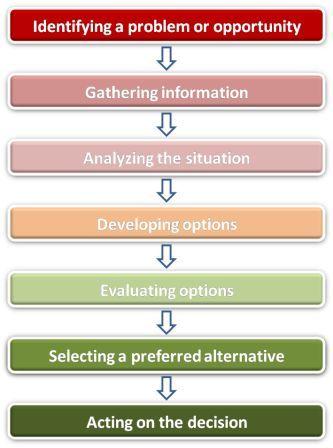
Rational Decision Making Model
Online > Metadata
https://the-happy-manager.com/article/rational-decision-making-model/
https://the-happy-manager.com/wp-content/uploads/rational-decision-making-model1.jpeg

1: Identifying a problem or
opportunity
The first step is to recognize a problem or to see opportunities that may be worthwhile. A rational decision making model is best employed where relatively complex decisions have to be made.
(So the first decision making lesson should be to ask yourself if you really have a problem to solve or a decision to make. Then read this article for more specific advice: Problem Solving Skill: Finding the Right Problem to Solve).
2: Gathering information
What is relevant and what is not relevant to the decision? What do you need to know before you can make a decision, or that will help you make the right one?
3: Analyzing the situation
What alternative courses of action may be available to you? What different interpretations of the data may be possible? Our Problem Solving Activity uses a set of structured questions to encourage both broad and deep analysis of your situation or problem.
4: Developing options
Generate several possible options. Be creative and positive. Read The Power of Positive Thinking for our five questions that create possibilities.
5: Evaluating alternatives
What criteria should you use to evaluate? Evaluate for feasibility, acceptability and desirability. Which alternative will best achieve your objectives?
6: Selecting a preferred
alternative
Explore the provisional preferred alternative for future possible adverse consequences. What problems might it create? What are the risks of making this decision?
7: Acting on the decision
Put a plan in place to implement
the decision. Have you allocated resources to implement? Is the decision
accepted and supported by colleagues? Are they committed to making the decision
work?
Competence & Mental Status
UNC School of Government (28
Pages)
https://www.sog.unc.edu/sites/default/files/course_materials/HillCompetenceMentalStatus.pdf
Competency is a legal concept; it
refers to having the. 'mental
capacity to decide in accordance with one's goals, concerns and values'.
What are the elements of
competence?
What are the 5 components of
competency?
AI Overview
The five core elements of
individual competency in professional and management frameworks are knowledge,
skills, attitude (or behavior), personal characteristics, and experience.
The 5 Core Components
Knowledge:
The facts, theories, and ideas you
understand about your job or industry.
Skills:
The practical abilities and
technical tools you use to perform tasks.
Attitude / Behavior:
Your mindset, work ethic, and how
you approach challenges and interact with others.
Personal Characteristics:
Your natural traits, emotional
intelligence, and personal qualities that shape how you react.
Experience:
The practical background and past
time spent applying your abilities in real situations.
(Note: In education and training
design, the "5 components of competency-based education" instead
refer to outcome frameworks, developmental progression, tailored learning,
competency-focused coaching, and programmatic assessment.)

Competency - There are 4
‘accepted’ standard elements:
- Communication of choice
- Understanding of information
- Appreciation of one’s situation & risks/benefits of choices made
- Rational decision-making
Courts prefer the first two,
psychiatry the latter
MAiD Competence 17 Items
HSF = High Scores are Favorable


https://www.linkedin.com/in/oswaldo-escalante-024a6018
LinkedIn · Oswaldo Escalante
90+ followers
Downey, California, United States
Student Services Specialist · Lynwood Unified School District
Brand New Day - Nov 2011 - Aug 2014 2 years 10 months
Recovery Counselor - Behavioral Health Services, Inc. Jan 2009

Compare
Oswaldo Escalante
Mr. Oswaldo O. Escalante is recognized for his expertise as
a student services specialist and counselor for the Student Services Department
for the Lynwood Unified School District. Compton/Lynwood, CA, February 15, 2023
- Oswaldo O. Escalante has been included in Marquis Who's Who. As in all
Marquis Who's Who biographical volumes, individuals profiled are selected on
the basis of current reference value.
Factors such as position, noteworthy accomplishments, visibility, and
prominence in a field are all taken into account during the selection process.
FYI
Jeff Gibbs
Jeff Gibbs is a Mental Health Rehab Specialist (MHRS)
and Social Service professional who worked at Brand New Day for over 11 years
(June 2011 – Dec 2022). He specializes in social services and, according to
LinkedIn, is based in the Los Angeles area, often involved in supporting mental
health and community wellbeing.
Escalante > Reynolds > Gibbs
Jessica Reynolds Brand New Day on Facebook

The Clinic – Central City Community Health Center – Garden Grove
https://housingadvisoryboard.blogspot.com
20191023-W: Housing Advisory – by Keith Torkelson
https://housingadvisoryboard.blogspot.com/2019/10/20191023-w-housing-advisory-by-keith.html
Oct 23, 2019
We are Mentalation Solutions Group (MSG). Dozens of Images
Effort
We are Mentalation Solutions
Group (MSG) and we engage in Advocacy and External Quality Review efforts about
Health & Human Services. Our specialty is Thanatology.
Central City Community Health Center's Online Review Report
https://www.scoredoc.com/ca/garden-grove/central-city-community-health-center/review-report-card/1580219/2641843
20260424-F: Average Star Rating = 1.7 | Total Reviews = 22
20260917-TH- Average Star Rating = 1.7 | Total Reviews = 22
Sample Review (EQR)
We are Mentalation Solutions Group (MSG) and we engage in Advocacy, and
External Quality Review, efforts about Health & Human Services. Keith was
first served by Martha G Gil a Central City RN during the summer of 2012. She was primarily Keith’s phlebotomist. We gave her a stellar review for her service
for year 2018. Currently, 2026, we give
Central City a Quick Stars Score of 4.5 of 5.0 Stars with 5.0 being Excellent.

Super Bios (Medium)
https://ktork46.blogspot.com/2016/12/keith-edward-torkelson-ms-super-bios.html
https://ktork46.blogspot.com/2013/01/keith-torkelson-curriculum-vitae.html
https://the-torkel-saga-2059.blogspot.com/2018/04/keith-edward-torkelson-ms-2018-bios.html
Scored by and for Keith “Buster” Torkelson on 20160615-W
Progressive Competency Evaluation 16 Items
(MSG-Derived)

ND = Not Demonstrated (Scores as a FAIL)
Scored by and for Keith “Buster” Torkelson, MS on 20160615-W
Progressive Competency Scale 15 Items
(MSG-Derived)

Progressive Competency Performance 18 Items
(MSG-Derived)

Progressive Stages 6 Items
(MSG-Derived)

How is it good help is hard to
get and keep for non-profits?
Non-profits struggle to get and
keep help due to chronic funding
restrictions, low salaries, and high burnout, often creating a
"survival mentality". High staff turnover—especially in
fundraising—averages just 16 months, breaking critical donor relationships.
This scarcity makes it hard to afford
talent or build long-term capacity.
How is it inferior case workers?
"Inferior" caseworkers, or more accurately, ineffective or "bad" caseworkers, are often created by systemic pressures, lack of training, and high burnout rather than just individual malice. According to user experiences and professional analyses, they are characterized by behaviors that fail to protect or support families. The term inferior case workers does not refer to a standard professional classification, but rather describes cases where a case worker's performance, resources, or systemic support fall below acceptable standards. In social work, healthcare, and legal systems, case workers are considered ineffective or "inferior" when specific systemic or individual failures compromise client care.
(MSG-Derived)
Professional Competencies Gaps 27 Items
IP = In Progress


Does the quality and competence
of your care coordinator matter?
Yes, the quality and competence
of a care coordinator are critical because they directly impact patient health outcomes, continuity of care, and
safety. A competent coordinator reduces fragmented care, manages
complex needs, and improves patient
satisfaction, while skilled coordination can improve outcomes for
individuals with multiple chronic conditions.
Outcomes for RDA-Modified Partnership Assessment
MSG-RDA-PV (16 Items)
Assess_Partnership_RDA_16070202_Gibbs V2026 (Has Assessment & Results)
Date Finalized: 20160821-SU
Calculations – Yields Partnership RDA Value
Scored by Keith “Buster” Torkelson, MS
HSF = High Scores are Favorable | Kline = Lanaii Kline (Oldest sister)

FYI – Aside - Mental Health Assessment (2012 - 208 Pages)
https://www.drugsandalcohol.ie/17625/1/MentalHealthAssessmentTools.pdf
Includes 30 Assessment Tools
*redacted due to copyright
Section 1: Mental Health
Screening Tools (Page Number)
- Mini-Mental State Examination (MMSE) 11
- KGV (Modified) Symptom Scale 17
- Risk Assessment Summary Department of Psychiatry, Portlaoise 65
- Risk Assessment Tool Longford/Westmeath MHS 66
- Depression/Anxiety/Stress Scale (DASS) 67
- PSYRATS – Hallucinations Subscale 75
- PSYRATS – Delusions Subscale 81
- Geriatric Depression Scale (GDS) 87
- Beck’s Depression Inventory (BDI) (*redacted) 91
- Beck’s Suicidal Intent Scale (BSIS) (*redacted) 95
- Beck’s Hopelessness Scale (BHS) (*redacted) 101
- Beck’s Anxiety Inventory (BAI) (*redacted) 104
- Anxiety Rating Scale (Zung) 107
- Rosenberg Self Esteem Scale 109
- Evaluative Belief Scale 112
- Sleep Scale 114
Section 2: Medication Related
Screening Tools
- LUNSERS – Side-effect rating scale 119
- DAI - Drug Attitude Inventory (DAI 30) 127
Section 3: Addiction Screening
Tools
- MAST - Michigan Alcohol Screening Tool (MAST 25) 131
- DAST - Drug Abuse Screening Tool (DAST 20) 135
- AUDIT – The Alcohol Use Disorders Identification Test 137
- CAGE - Alcohol Misuse Screening Tool 141
Section 4: Living Skills
Screening Tools
- Life Skills Profile (LSP 20) 145
- Social Functioning Scale (SFS) 157
- BARTHEL Index of Daily Living 175
- Social Network Map (SNM) 177
- Camberwell Assessment of Need (CAN) 180
- Relative Assessment Interview (RAI) 190
The Meaning of Redacted
Redacted means that specific words, numbers, or sections
have been deliberately removed, blocked out, or hidden from a document before
it is shared with the public.
Why Documents Are Redacted
Privacy protection:
Hiding personal details like social
security numbers, birth dates, or addresses.
Legal compliance:
Removing names of minors, trade secrets,
or protected health data.
National security:
Concealing classified government or military
secrets.
Ongoing investigations:
Blocking details that might interfere
with an active police case.
Common Methods
Blacking out:
Covering text with solid black bars.
Labeling:
Replacing text with brackets like [REDACTED].
Digital scrubbing:
Permanently stripping hidden metadata and
underlying text layers so the data cannot be recovered.
FYI – AI - You can test or apply these censoring effects
yourself using free online tools like Redacted.
Would you like to know how to properly redact a PDF
or digital document, or are you looking for information on a specific redacted
government record or case?
Informed Consent – Competence
The Hopkins Competency Assessment
Test: A Brief Method for Evaluating Patients’ Capacity to Give Informed Consent
FYI - The Hopkins Competency Test
- Jeffrey S. Janofsky, M.D.
http://www.jeffreyjanofsky.com/media/pdf/The-Hopkins-Competency-Assessment-Test.pdf
by JS Janofsky · 1992 · Cited by 349
The Hopkins Competency Assessment
Test (HCAT), a brief instrument for
evaluating the competence of patients to give informed consent or write advance
directives, consists of a short essay and a questionnaire for
determining patients’ understanding of the essay. In a study to validate the
instrument, 41 medical and psychiatric inpatients answered the questionnaire
after reading the essay while hearing
it read aloud. A forensic psychiatrist who was blind to the HCAT scores
later examined the patients for competency. A subject’s number of correct
answers to the HCAT questionnaire was an accurate
indicator of clinical competency as assessed by the psychiatrist. The
results suggest that the HCAT is a useful too/for rapidly screening patients
for competency to make treatment decisions.

Grounds for LSP Conservatorship
An LPS (Lanterman-Petris-Short) conservatorship in California is
established for adults with severe mental illnesses (listed in the DSM) who are
deemed "gravely disabled"—meaning they are unable to provide for their own basic
needs for food, clothing, or shelter due to that illness. It requires proof of
a current, treatable mental disorder and is designed to provide involuntary treatment
or secure placement, usually lasting
one year, often for those non-compliant with treatment.
Key Grounds for LPS Conservatorship
Grave Disability
The primary requirement is that the person is, as a result of a mental disorder, unable to provide for their own basic personal needs (food, clothing, or shelter).
Specific Mental Disorder
The disability must stem from a mental illness defined by the Diagnostic and Statistical Manual of Mental Disorders (DSM), such as schizophrenia, bipolar disorder, or schizo-affective disorder.
Inability to Accept Treatment
The person is unwilling or incapable of accepting voluntary treatment.
Chronic Alcoholism
In some cases, severe, disabling chronic alcoholism may be grounds.
What "Gravely Disabled" Means
Safety Risk
The individual cannot live safely on their own, often due to an inability to manage nourishment or hygiene.
Not Just Homelessness
Being homeless alone does not meet the criteria; it must be a direct result of mental illness rendering them unable to seek food or shelter.
Current Danger
The person must be a present
danger to themselves, not just a future risk.
LPS - Duration
Lasts one year, renewable annually.
Process
Requires a court hearing, which may involve a jury trial if requested, where the, burden of proof is beyond a reasonable doubt.
Rights
The conservator may have the
power to place the individual in a locked
facility and make mental health treatment decisions, including
medication.
Why are skilled nursing facilities locked facilities?
Skilled nursing facilities use
locked doors primarily to protect residents who are at risk of wandering or
leaving unsafely due to cognitive decline or memory loss.
Reasons for Locking Doors
Preventing Elopement:
Residents with
dementia or Alzheimer's disease may wander off, get lost, or put themselves in
severe physical danger from traffic, weather, or falls.
Clinical and Safety
Needs:
Regulations
like the Life Safety Code permit facilities to lock specific doors
when it addresses the direct clinical or safety needs of the residents.
Managing Distressed
Behavior:
Securing units
helps protect individuals who experience severe disorientation, delusions, or
agitation that impairs their judgment.
Legal and Ethical Boundaries
Not Entirely Locked:
Whole
buildings are rarely locked down entirely; restrictions are usually confined to
specialized memory care units or specific exit points.
Resident Rights:
Residents who
are legally and mentally competent retain the right to come and go, and
facilities cannot involuntarily hold them without proper legal or medical
authorization.
FYI – AI - If you'd like, I can
provide more information on: The difference between skilled
nursing and memory care access rules. How facilities balance resident
autonomy with safety
Mental Health Competency
Mental health competency refers to an individual's capacity for rational decision-making regarding their care, involving understanding, appreciating, reasoning, and expressing choices, while for professionals, it means skills in communication, crisis intervention, person-centered care, ethics, and cultural responsiveness to support others. It's a fluid concept, assessed in specific contexts (like legal or medical), and involves foundational elements for general well-being and thriving despite challenges.
For Individuals (Decision-Making Capacity)
- Understanding
- Grasping the situation, information, risks, and benefits.
- Appreciation
- Recognizing the personal significance of the information.
- Reasoning
- Applying information logically to their situation.
- Expressing a Choice
- Clearly communicating a preference or decision.
For Mental Health Professionals
(Core Competencies)
Using effective skills and a tailored approach.
Preventing and intervening in crises.
Upholding standards, promoting advocacy, and ensuring safety.
Applying multicultural competencies.
Integrating mental health into overall care.
Continuous learning and training.
Key Aspects
Context-Specific
Context-specific competency, particularly
regarding decision-making capacity, is generally understood to be task-specific, fluid, and situational
rather than a global, all-or-nothing trait. A person may be considered
competent to make one type of decision (e.g., daily activities) while lacking
the capacity for more complex decisions (e.g., financial management or major
medical treatment) at the same time.
Fluid
It can change over time due to
illness, treatment, or life events.
Foundation for Well-being
Beyond disorders, it involves resilience, coping, and functioning well.
Standardized Instruments
Mental competency assessment
tools are specialized, standardized
instruments—such as the MacArthur Competence Assessment Tool
(MacCAT-CA) for legal contexts or the Mini-Mental State Examination (MMSE) for
cognitive screening—designed to evaluate a person's ability to understand
information, make decisions, and communicate choices. These tools are used in
forensic, clinical, and social care settings to measure cognitive function,
legal capacity, or capacity to make
decisions regarding care.
FYI - The Mini Mental State
Examination (MMSE) – 2 Pages
https://cgatoolkit.ca/Uploads/ContentDocuments/MMSE.pdf
By L Kurlowicz · Cited by 445 —
It is an 11-question measure that tests five areas of cognitive function:
orientation, registration, attention and calculation, recall, and language.
Appendix – BHSA Values Mission Vision
The California Behavioral Health Services
Act (BHSA) (formerly the Mental Health Services Act) has a core mission,
vision, and set of values aimed at
transforming state behavioral health care.
Vision
To build an equitable,
integrated, and responsive behavioral health system where all
Californians—especially those with the most serious mental health and substance
use disorder (SUD) needs—have access to coordinated care, housing, and support to promote recovery, stability, and
overall well-being.
Mission
To modernize and reform
California's behavioral health system by prioritizing early intervention,
community-based services, treatment for mental health and substance use
disorders, housing solutions,
and workforce expansion while maximizing transparency, equity, and
accountability at both state and local levels.
Core Values
Equity & Inclusion:
Eliminating
disparities in care and ensuring culturally competent services reach
historically underserved and vulnerable populations.
Accountability &
Transparency:
Tracking
outcomes, ensuring responsible stewardship of public funds, and maintaining
clear oversight at state and local levels.
Compassion &
Person-Centered Care:
Focusing on whole-person wellness, early
intervention, and actively supporting individuals and their families along the
path to recovery.
Collaboration:
Partnering
across communities, schools, state departments, and local agencies to connect
services seamlessly.
Innovation:
Expanding workforce capacity and adopting modern, evidence-based approaches (such as school-linked mental health and integrated substance use supports).
FYI – AI - If you are looking for
information specific to a particular county's implementation
or need details on the Three-Year Integrated Plan for BHSA in
your area, let me know!


No comments:
Post a Comment